Apple Watch Water Resistance Explained: Swimming, Showers & More

Apple Watch is designed to handle water in everyday life, but that does not make it fully waterproof. It can handle splashes, rain, handwashing, and, on most newer models, swimming. That makes it a very practical device for people who wear it all day, work out often, or simply do not want to worry every time they get a little wet.
Still, there are limits. Hot showers, soap, strong water pressure, and repeated exposure can wear down the seals over time, which is why water resistance should be treated as protection with boundaries, not a permanent shield. If you know what the watch can handle and what it cannot, you can use it with a lot more confidence.
What Apple Watch Water Resistance Really Means
When Apple says a watch is water-resistant, it means the device is built to withstand water up to a certain point. It does not mean water can never cause damage, and it does not mean the protection lasts forever. Apple Watch is made for practical, real-world use, not for unlimited time in every kind of wet environment.
Most newer models are designed for everyday exposure and shallow-water use. Apple Watch Series 2 and later are built for swimming, while Apple Watch Ultra models are designed for more demanding water use than standard models. That difference matters if you spend a lot of time around pools, the ocean, or other wet conditions.
Can You Swim With an Apple Watch?
Yes, if you have a modern model, swimming is usually fine. Pool swims and many open-water swims are supported on Apple Watch Series 2 and later. For many people, that makes the watch a useful workout tool, not just a timepiece.
That said, swimming is not the same as diving or fast water sports. Activities like scuba diving, water skiing, or anything involving strong water pressure are not meant for standard Apple Watch models. Apple Watch Ultra is the exception for more demanding water use, but even then it is still important to follow Apple’s model-specific guidance.
Can You Wear an Apple Watch in the Shower?
You can, but it is not the best habit. Soap, shampoo, conditioner, and hot water can be rough on the seals over time. A quick shower probably will not cause immediate trouble, but repeated exposure is harder on the watch than plain water.
If you want the watch to last longer, taking it off before showering is the safer choice. That is especially true if you use very hot water or strong shower pressure. The more often the watch is exposed to those conditions, the more wear it can take.
Pool Water, Ocean Water, and Fresh Water
Pool water is usually okay for supported models, though chlorine can leave a residue. Ocean water is more corrosive because salt can accumulate around the speaker, buttons, and crown. Fresh water is the least stressful, but it still makes sense to dry the watch carefully afterward.
After swimming in salt water or a pool, rinse the watch with fresh water and dry it gently. A soft, lint-free cloth is enough for most cases. This simple habit helps keep buildup from settling into small openings and moving parts.
How to Use Water Lock on Apple Watch
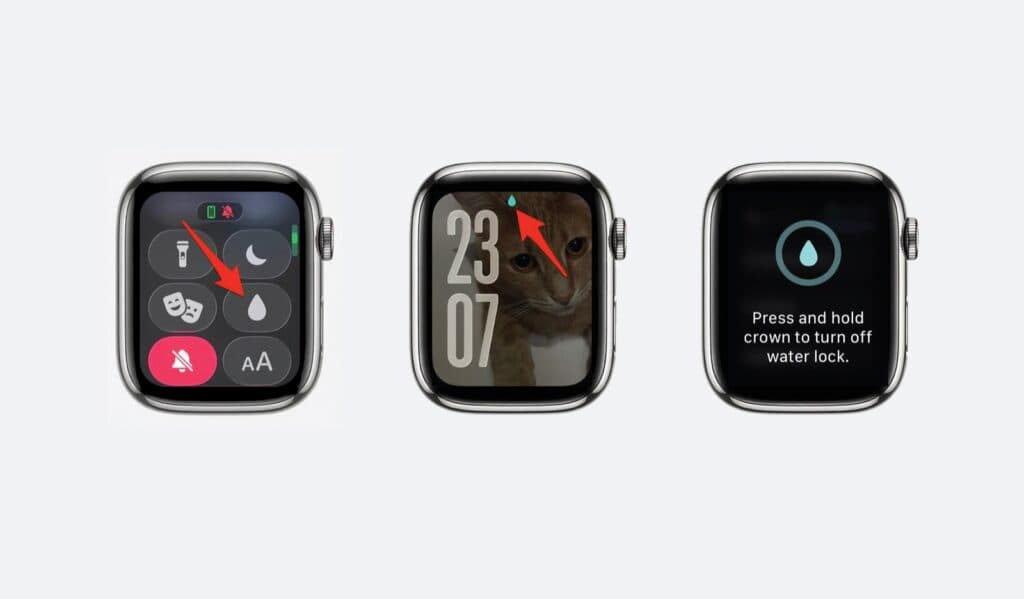
Apple Watch includes Water Lock to help keep the screen from reacting to water. It is useful before swimming or any time you expect the watch to get wet. After a swim, turning the Digital Crown helps clear water from the speaker area.
To turn Water Lock on:
- Press the side button to open Control Center.
- Tap the Water Lock icon, which looks like a water droplet.
- Confirm that the Water Lock symbol appears on the screen.
To turn Water Lock off:
- Wake the watch.
- Press and hold the Digital Crown until the display unlocks and the water is ejected.
- Wait a few seconds if the watch is still wet.
- Dry it with a soft, lint-free cloth before wearing or charging it again.
Why Aftercare Matters
Aftercare matters just as much as the swim itself. Dry the watch well, avoid heat, and do not use compressed air or harsh cleaners. Good care helps preserve the watch’s resistance for as long as possible.
What Not to Assume
Not every Apple Watch has the same level of protection. The original Apple Watch and Apple Watch Series 1 are not meant for swimming the way newer versions are. If you are using an older watch, it is better to be cautious than to assume it can handle the same conditions.
It is also worth remembering that water resistance can weaken with age. Wear and tear, drops, and damage to seals can all reduce how well the watch handles water. Even a watch that has done fine in the past may become less reliable over time.
Final Thoughts
Apple Watch is useful around water, but it works best when you understand its limits. Swimming is usually fine on newer models, showers are still a gray area, and simple aftercare can make a real difference over time. Treat water resistance as a helpful feature, not a promise that nothing can go wrong.
If you want the watch to last, a little caution goes a long way. Rinse it after salt water or pool use, dry it well, and avoid habits that expose it to heat or soap too often. Those small steps help keep it working the way it should.
Frequently Asked Questions
Yes, but it is not recommended as a regular habit. Soap, shampoo, conditioner, and hot water can wear down the seals and other water-resistant parts over time.
Yes. Apple Watch Series 9 is designed for shallow-water activities like pool swims and open-water swims, but it is not meant for scuba diving or high-pressure water sports.
Yes, supported models can handle ocean swims, but you should rinse the watch with fresh water afterward because salt water is harsher than fresh water.
No. Apple Watch is water-resistant, not waterproof, and that resistance can diminish as the watch ages.
Standard Apple Watch models are not meant for diving. Apple Watch Ultra and Ultra 2 support more demanding water use, including recreational scuba diving to 40 meters, but you should still follow Apple’s model-specific limits.
Yes. After swimming, especially in salt water or chlorinated water, rinse the watch with fresh water and dry it with a soft, lint-free cloth.
No. Water resistance is not permanent. Normal wear, drops, chemicals, and age can reduce how well the watch resists water over time.